What data can you get from our horse racing API?
See exactly which racing feed families RacingAPI.net currently exposes, with practical limits on form, odds, weather, media, tips and Enterprise MCP access.
Published 30 Oct 2026Updated 30 Oct 20267 min read
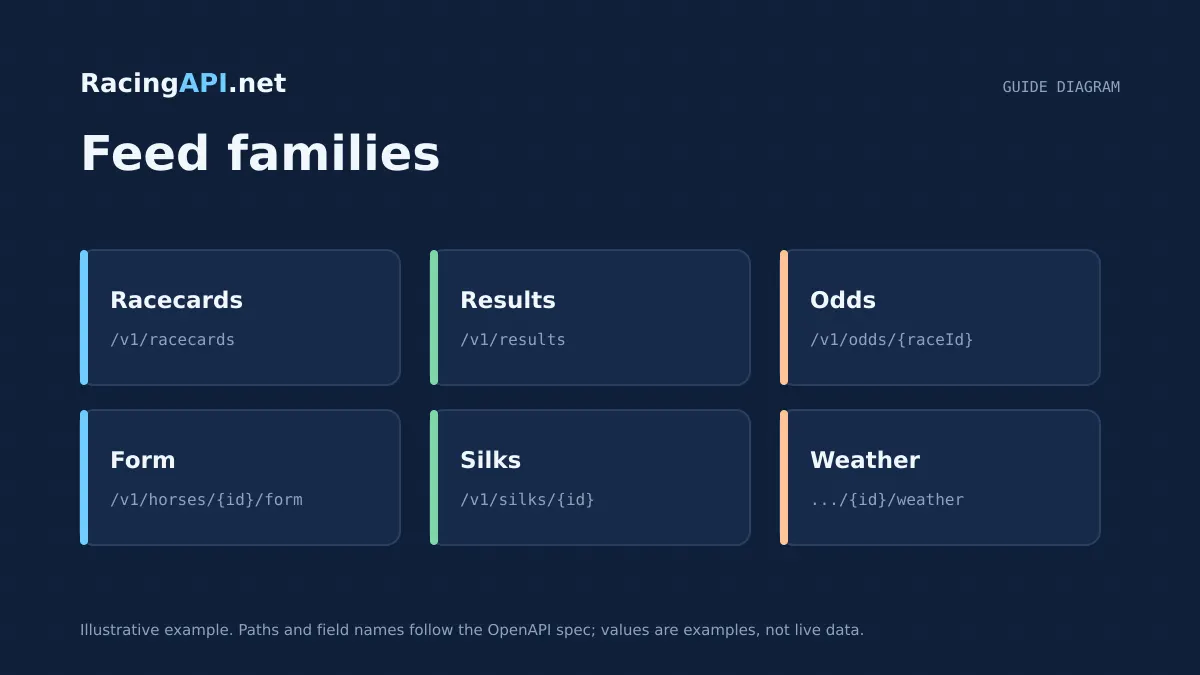
If you are deciding whether RacingAPI.net covers your use case, the most useful question is not simply what endpoints exist, but what each feed actually contains and where the boundaries are. The current catalogue is built around UK and Ireland racing, delivered through the combined region=uk feed, and the data is organised into racecards, results, horses, connections, courses, odds, weather, media and Enterprise-only insights.
The important distinction is that several feeds are contextual rather than archival. Horse form and connection statistics are supplied from the selected daily feed, not as complete career histories. Odds preserve observed bookmaker prices rather than imposing a standardised market view. Weather is a course-location forecast with source attribution. Enterprise adds live AI-assisted tips and an MCP server for compatible AI clients. This guide explains what you can reliably get from each family and what you should not assume is included.
Try the documented request
Start with the combined UK and Ireland racecards. Reuse returned IDs and the selected feed date for related race, result, odds and runner requests.
# Set RACINGAPI_KEY on your server; use IDs returned by the feed.
# FEED_DATE must be YYYY-MM-DD in the feed context you want.
curl --fail-with-body --max-time 15 --get \
  "https://racingapi.net/v1/racecards" \
  -H "X-API-Key: ${RACINGAPI_KEY}" \
  --data-urlencode "region=uk" \
  --data-urlencode "date=${FEED_DATE}" \
  -H "Accept: application/json"
Run this on your server, not in public browser code. Replace the environment variables before running it. Respect the response cache headers and Retry-After; do not retry failed requests without a limit.
Racecards, race details and results
The core of the catalogue is the daily racing feed. Racecards return UK and Irish meetings with declared runners, and the race details endpoint expands a selected race into its own structure. That means you can build a race-day view from the feed rather than stitching together separate sources. The catalogue is intentionally feed-first: you receive the races that are present for the requested region and date, not a complete long-term archive of every historical meeting.
Results are exposed separately from racecards, with finishing positions and the result data available for a chosen race. That split is important if your application needs to show ante-post information first and later reconcile it with the finishing order. The result family is designed for what happened in the race, while racecards are designed for what is declared before the off.
- Racecards: meeting-level card data and declared runners
- Race details: one race expanded from the regional date feed
- Results: finishing positions and available result fields
- Best used for race-day browsing, settlement checks and post-race updates
Horse profiles and form statistics
Horse search and horse profiles are both scoped to the declared daily feed. Search helps you find runners in that feed, while the horse profile endpoint returns the runner record and the form summary that is available for that horse in the selected context. The key point is that this is not a complete career database. If you need every run a horse has ever had, you should not expect that from this catalogue.
The horse form statistics endpoint is especially useful when you need race-specific context: race record, conditions, headgear, class rating and connections where present. Availability varies by horse and by the daily feed in question. In practice, this makes it well suited to race cards, shortlist tooling and in-race analysis where the objective is to surface what is relevant today, not to reconstruct an exhaustive biography.
- Horse search works within the specified regional daily feed
- Horse profiles return the runner details and feed-based form summary
- Horse form statistics are contextual, not complete career history
- Fields vary by horse and by what is present in the daily feed
Trainer and jockey connection data
RacingAPI.net exposes jockey and trainer connection endpoints to show how the declared runners relate to their connections inside the selected feed. These are not career-statistics products. They are designed to answer questions such as which horse a jockey is booked to ride, which runners are declared for a trainer, and what horse-specific connection statistics are available in that daily context.
That makes them useful for racecards, comparison views and internal tooling where you want a pragmatic snapshot rather than a historic leaderboard. The catalogue explicitly does not present these endpoints as full career databases, so developers should avoid interpreting the figures as comprehensive all-time records. If you present them in a user interface, the safest pattern is to label them as feed-scoped connection data.
- Jockey connections: bookings and horse-specific connection statistics
- Trainer connections: declared runners and horse-specific connection statistics
- Both are scoped to the selected daily feed
- Not full career statistics
Courses and racecourse weather
The course family includes racecourses that appear in the selected regional feed, plus a course detail view that expands a specific track into its races. As with the rest of the catalogue, this is feed-aware rather than a universal directory of every racecourse that might exist in theory. It is meant to support the meetings currently present in the region=uk feed, which includes both UK and Irish cards.
Weather is available as a separate racecourse endpoint and is not the same thing as official going. The weather feed provides course-location forecasts from MET Norway, including temperature, rainfall, wind speed, humidity and the forecast source. Because the forecast is sourced and attributed, your application should retain the returned attribution and treat the weather data as a distinct layer alongside official going, not a replacement for it.
- Racecourses are limited to those appearing in the selected feed
- Course details return a course and its races from that feed
- Weather includes temperature, rainfall, wind and humidity
- Forecast weather is separate from official going
Odds and media assets
The odds endpoint returns bookmaker prices observed in the live UK feed. The design choice here is to preserve the source price strings and the bookmaker identifiers rather than forcing them into a normalised odds model. That means you can surface what was observed, compare prices, or display each-way information where present, but you should not assume guaranteed bookmaker coverage, a standard price format or a fixed refresh interval.
For media, RacingAPI.net supplies racing silks as validated PNGs for declared horse and race IDs when image-feed access is enabled. These are not photographs and should be treated as colour assets for runners, ownership or race presentation. Missing images return 404, which is useful when you are building a graceful fallback in a user interface.
- Odds preserve observed bookmaker price strings
- Bookmaker coverage is not guaranteed on every race
- Each-way data is included where present
- Silks are validated racing-colour PNGs, not photographs
Enterprise tips and MCP for AI clients
Enterprise adds live AI-assisted tips as an active product feature rather than an experimental preview. The tips family includes pre-generated selections with saved explanations, status, versioning and observed odds context. There is also a race selection endpoint and a separate explanation endpoint for retrieving the same saved two-sentence explanation without re-running AI. These are designed to be read as live insight feeds, not as guarantees of outcome.
For compatible AI clients, Enterprise also includes a read-only MCP server. This is not a separate racing dataset; it is a controlled access method for the same Enterprise capability set. Access is through explicit OAuth consent or an API-key header in supported developer clients. Enterprise MCP calls share the Enterprise rate limit and monthly quota rules, so they should be treated as part of the normal API usage model, not as an unlimited side channel.
- Enterprise tips are live, saved and versioned
- Selection and explanation can be retrieved separately
- MCP is read-only and intended for compatible AI clients
- Enterprise usage still follows normal rate and quota rules
Access model and the boundaries that matter
Before you integrate any feed family, it helps to understand the access rules because they shape what data you can actually retrieve. Requests are made to https://racingapi.net using the X-API-Key header, and the key stays server side. Access requires a completed card-required seven-day trial checkout or an active subscription; signup alone is not enough. There is no permanent free tier, and monthly usage is counted across all keys against the same account.
The available catalogue is UK and Ireland only, via region=uk. That single region includes both countries, and requests for other regional feeds are rejected. You should also treat historical depth carefully: horse form, connection data and course coverage are feed-scoped, not universal historical warehouses. If your product needs a complete career chronology or a full market-wide dataset, this catalogue is not designed to promise that.
- Use X-API-Key against https://racingapi.net
- Access requires trial checkout or an active subscription
- region=uk covers both UK and Ireland
- Monthly quota is shared across all keys on the account
Key takeaways
- RacingAPI.net’s catalogue is organised around current UK and Ireland racing feeds, not a complete historical warehouse.
- Horse form, jockey and trainer data are feed-scoped snapshots, while odds and weather preserve their own source-specific constraints.
- Enterprise adds live tips and MCP access, but the same quota, access and regional boundaries still apply.
Feed-family explorer
What each family covers, with links to the documentation that defines it. Plan availability is listed on the pricing page.
Racecards
All plans- UK and Irish meetings, races and declared runners
- Supplied identifiers for joining detail requests
- Going, distance and race context as supplied
Frequently asked questions
Does the API give complete horse career histories?
No. Horse profiles and horse form statistics are supplied from the selected daily feed. They are useful for contextual form, race record and related details, but they are not complete career archives.
Can I treat jockey and trainer data as full career statistics?
No. The jockey and trainer endpoints provide connection data within the selected feed, including bookings and horse-specific statistics where present. They are not sold as full career-statistics datasets.
Are the weather fields the same as official going?
No. Weather is a course-location forecast from MET Norway and is separate from official going. You should keep the attribution returned by the endpoint and present weather as a distinct layer.
Are the odds guaranteed to include every bookmaker?
No. The odds feed preserves observed bookmaker prices from the live UK feed, but coverage, format and refresh frequency are not guaranteed to be uniform across every race.
What does Enterprise add beyond the REST feeds?
Enterprise adds live AI-assisted tips with saved explanations and a read-only MCP server for compatible AI clients. It does not change the underlying scope of the UK and Ireland racing catalogue.
Related guides
All guides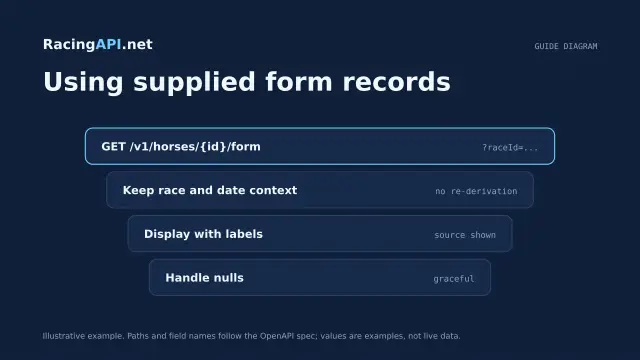 Racing data
Horse form and statistics API: using supplied records
Learn how to read RacingAPI.net horse form and statistics as supplied daily-feed summaries, with sensible handling of missing values, sample size and regional context.
 Racing data
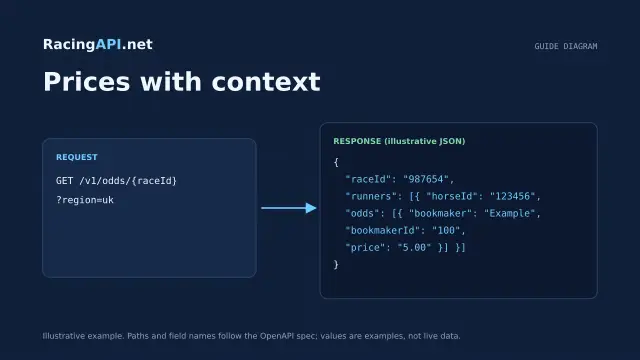
Horse racing odds API: prices with context
Learn how RacingAPI.net delivers observed horse racing odds with timestamps, price formats, missing-price handling and useful context for own-site comparison.
 Racing data
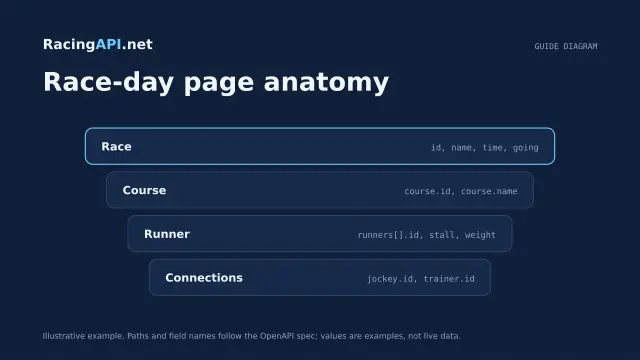
Horse racing racecards API: building a race-day page
Build a race-day page with meeting, race and runner data, careful declaration handling, and reliable detail fetching from RacingAPI.net.