Free horse racing API: what developers should know
Learn how RacingAPI.net’s seven-day card-required trial works, what “free” really means, and how to judge an integration before your monthly plan renews.
Published 30 Oct 2026Updated 30 Oct 20267 min read
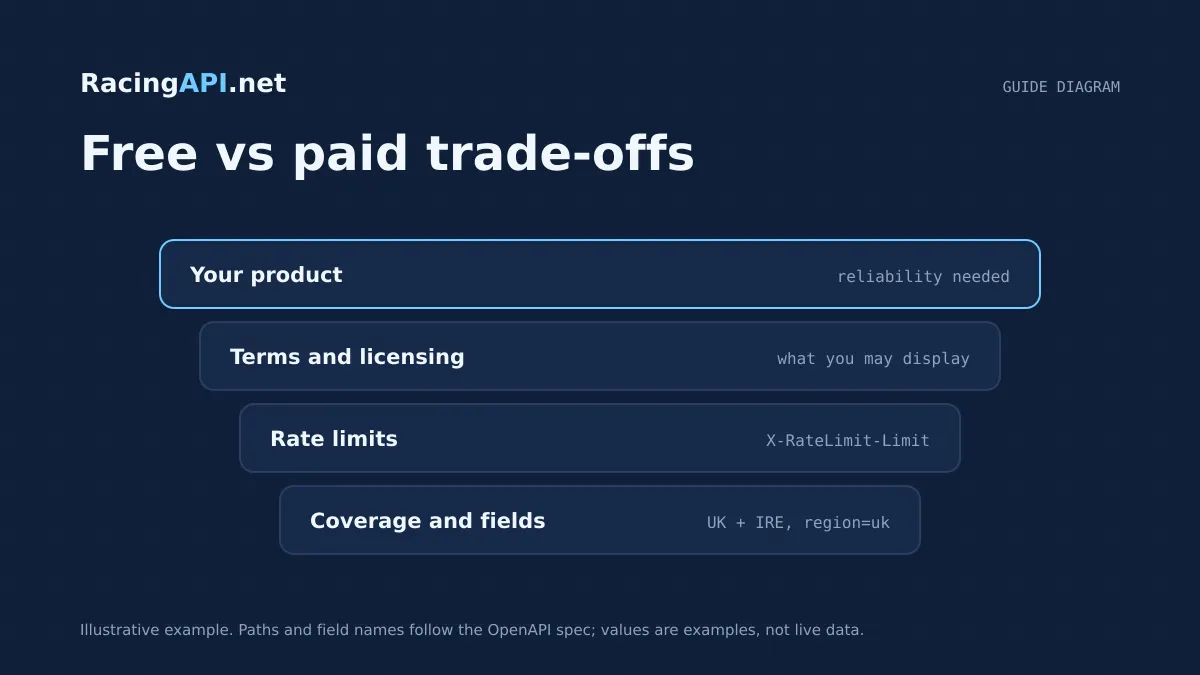
If you are searching for a free horse racing API, the first decision is not about endpoints or JSON structure. It is about whether you need a genuinely free tier or a short, honest trial that lets you validate an integration before paying.
RacingAPI.net does not offer a permanent free plan. Instead, eligible new customers can complete a card-required seven-day trial, then cancel before the exact end time if they decide not to continue. That makes the trial useful for proving your integration works, but not for indefinite production use.
Try the documented request
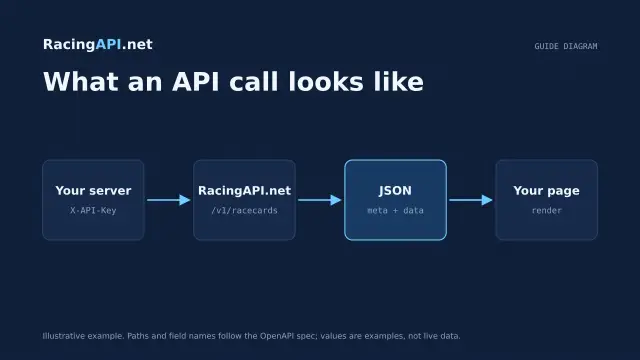
Start with the combined UK and Ireland racecards. Reuse returned IDs and the selected feed date for related race, result, odds and runner requests.
# Set RACINGAPI_KEY on your server; use IDs returned by the feed.
# FEED_DATE must be YYYY-MM-DD in the feed context you want.
curl --fail-with-body --max-time 15 --get \
  "https://racingapi.net/v1/racecards" \
  -H "X-API-Key: ${RACINGAPI_KEY}" \
  --data-urlencode "region=uk" \
  --data-urlencode "date=${FEED_DATE}" \
  -H "Accept: application/json"
Run this on your server, not in public browser code. Replace the environment variables before running it. Respect the response cache headers and Retry-After; do not retry failed requests without a limit.
Free forever is not the same as a trial
A free forever API and a time-limited trial solve different problems. A free tier is usually about ongoing low-volume use with no payment method on file. A trial is about evaluation: you are allowed to test the real service, but the clock is running and the service is designed to convert to a paid plan unless you cancel.
With RacingAPI.net, the honest answer is that there is no permanent free tier. Access is available through an active subscription, a confirmed trial, or explicit administrator-approved access. That matters because a developer can build against the live feeds during the trial, but should treat the window as a decision period rather than a long-term sandbox.
For integration planning, this distinction is important. A free tier can hide costs for months; a trial forces you to check whether the data, the rate limits and the daily-feed coverage are actually suitable for your application before the billing cycle begins.
How the seven-day card-required trial works
The trial is available to eligible new customers after completing Stripe Checkout with a card. Signing up alone does not start the trial. Once activated, the trial lasts seven days and renews into the selected monthly plan automatically unless you cancel before the exact end time shown in your dashboard.
That auto-renewal is worth planning for. If you want to evaluate the API without being charged for the following month, set a reminder from the moment you start the trial, not on day six. Because the end time is precise, you should not assume that cancelling later in the day will still be in time.
The trial is not a permanent free account with reduced features. It is the real service, subject to the same practical rules you will face on a paid plan: requests are authenticated with your own RacingAPI.net key in the X-API-Key header, and your usage is counted against the account rather than split into a separate test quota.
- Card required to start the trial
- Seven days from the exact activation time
- Auto-renews unless cancelled before trial end
- No permanent free tier
What to test during the trial
The best use of a trial is not to call every endpoint once. It is to test the parts that determine whether you can ship. Start with the requests you will actually run in production: a region-and-date racecards call, a race detail lookup, results retrieval and any horse-profile or connection views your interface needs.
If your product depends on the UK and Ireland feed, confirm that region=uk returns both countries exactly as intended. That is the combined feed, so you do not need separate regional logic for Ireland. Also check how your app handles the fact that horse form and connection statistics are supplied from the daily feed context rather than a full career database.
If you use the odds feed, inspect the price strings exactly as returned. RacingAPI.net preserves observed bookmaker prices and timestamps; it does not promise that every bookmaker will appear on every race, so your UI should tolerate sparse markets and changing availability.
A trial is also the time to verify your own caching, retry and display logic. For non-personal data, caching can reduce unnecessary round trips, but you should not let one user’s response leak into another user’s view. If you hit HTTP 429, respect Retry-After and back off rather than hammering the API.
Plan limits you should model before launch
The trial is useful precisely because it exposes the same rate and quota rules you will need to design around. Developer includes 10,000 requests per calendar month at 2 requests per second. Professional includes 100,000 requests per calendar month at 5 requests per second. Enterprise includes unlimited monthly requests at 10 requests per second.
Do not confuse monthly quota with per-second throughput. Unlimited monthly requests does not mean unlimited burst capacity, and higher plan limits still require sensible client-side throttling. Monthly usage resets on the first day of each calendar month in UTC, and changing plans does not reset accumulated usage.
Limits apply across all keys on the account, so a team should measure shared consumption rather than assuming each developer gets a separate allowance. If your integration does background refreshes, schedule them carefully and test how many calls are needed for a full working day of use.
- Developer: £29, 10,000 requests, 2 requests per second
- Professional: £79, 100,000 requests, 5 requests per second
- Enterprise: £99.99, unlimited monthly requests, 10 requests per second
How to evaluate whether the API is fit for production
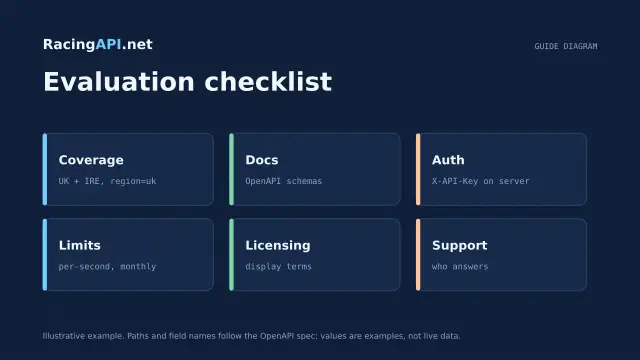
A good trial evaluation answers three questions: do you get the data you need, can your application consume it reliably, and does the coverage match the product you intend to build. For RacingAPI.net, that means checking the daily feed surface, the shape of racecards and results, and whether the data is complete enough for your chosen user journey.
If you are building a race-day app, test the sequence from racecards to race details to results without assuming the same record exists in every endpoint. Some views depend on the selected regional daily feed, so your integration should cope with absent fields or a horse that simply is not present in the current feed.
This is also the right time to validate display logic around weather and going. RacingAPI.net’s weather endpoint provides course-location forecasts from MET Norway, which are separate from official going. If you show both, keep them clearly labelled, retain attribution, and do not merge them into one misleading condition value.
For teams planning an internal tool, the trial should also cover how keys are issued and stored. Customer keys are created by you, while provider credentials remain server side. Keep the key out of frontend code, rotate it only through your own secure process, and make sure your usage reporting can show who used what during the trial.
When a trial is not enough
Some products can be validated in a week; others cannot. If your idea requires long-running historical analysis, the seven-day trial may be enough to prove connectivity but not enough to prove your full data strategy. That is because horse form and connection statistics are daily-feed summaries, not complete career histories, and the published catalogue does not present full long-term statistical coverage as a finished promise.
If you are depending on tips, note that those are Enterprise live features and should be evaluated as such. They provide saved selections and saved two-sentence explanations, but they are not a claim of guaranteed outcomes. A trial on a lower plan will not tell you whether you need Enterprise-only functionality.
In practical terms, a trial is excellent for checking whether the API integrates cleanly into your stack, how the requests are authenticated, and whether the response shapes suit your models. It is less suitable for proving long-term commercial viability if your product depends on months of historical depth or features outside the enabled core racing endpoints.
A sensible way to use the seven days
Treat the trial like a deployment rehearsal. On day one, make a minimal authenticated request and confirm you can read and store the response. On day two, test the endpoints your product cannot live without. On day three, review rate usage and decide whether your planned refresh pattern is efficient.
By mid-trial, you should know whether the coverage and cadence fit your product. If you are satisfied, leave renewal in place and move toward production. If you are not, cancel before the exact end time in the dashboard and treat the trial as a successful validation exercise.
The key point is honesty: a card-required trial is not free forever, but it can still be the right way to assess a racing data API. It gives developers enough real service exposure to make a proper technical decision before the first paid month begins.
Key takeaways
- RacingAPI.net does not offer a free forever tier; it offers a seven-day card-required trial that renews automatically unless cancelled.
- Use the trial to test your real production flow, especially region=uk coverage, request limits, key handling and the data shapes your app will store.
- A good trial decision depends on fit, not just cost: confirm that daily-feed coverage, rate limits and endpoint behaviour suit your product before renewal.
Request-budget planner
Estimate calls from one shared server-side poller. Browser visitors should read your cache, not the API.
- Calls per day
- 1,800
- Calls per month
- 54,000
- Average rate
- 0.05 req/s
An estimate only. The average rate applies during active hours, not to bursts: space requests evenly to respect your per-second limit. Inputs are bounded to 1–86,400 seconds, 0–24 hours, 0–100 endpoints and 0–31 days. This excludes retries, detail fetches and other workers, and does not imply data freshness or plan entitlement. Compare allowances on the pricing page.
Frequently asked questions
Is RacingAPI.net a free horse racing API?
No permanent free tier is offered. RacingAPI.net provides a seven-day card-required trial for eligible new customers, then it renews into the chosen monthly plan unless cancelled before the exact end time shown in the dashboard.
Do I need to enter a card to test the API?
Yes. The trial starts after completed Stripe Checkout with a card. Signing up alone does not activate access, and the trial auto-renews monthly unless you cancel in time.
What should I test during the trial?
Test the exact requests your product will use, such as racecards, race details, results and any horse or connection views you need. Also check your handling of region=uk, rate limits, 429 responses and the shape of odds or weather data.
Does the trial have the same limits as paid plans?
The trial is intended for evaluation of the live service, so you should plan around the same account-level request limits and monthly quota model. Developer is 10,000 requests per calendar month at 2 per second, Professional is 100,000 at 5 per second, and Enterprise is unlimited monthly requests at 10 per second.
Can I cancel before I am charged?
Yes. The trial renews automatically unless you cancel before the exact trial end time in your dashboard. If you only want to evaluate the service, set a reminder as soon as the trial begins.
Sources and references
External references for background only; they do not endorse RacingAPI.net.
Related guides
All guides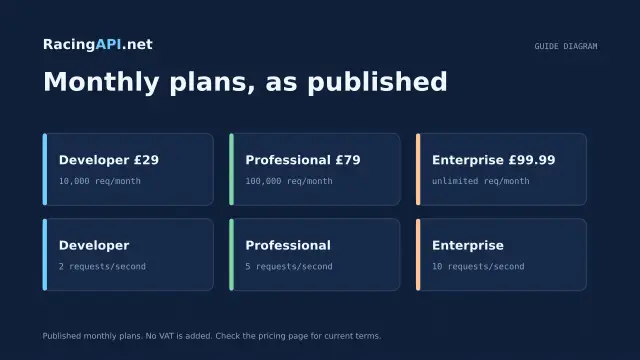 Getting started
Horse racing API pricing: choosing your monthly plan
Compare RacingAPI.net monthly plans by request volume and rate limits, and choose the right tier for racecards, results, odds and Enterprise tips.
 Getting started
How to choose the best horse racing API
A practical framework for choosing a horse racing API: coverage, authenticated samples, schema stability, freshness, permissions, and real integration cost.
 Getting started
What is a horse racing API?
A beginner’s guide to horse racing APIs: requests, authentication, JSON responses, racing hierarchy, and how RacingAPI.net fits into a website journey.